Layer L1
Situation
Establish the situation the AI must understand before it can be useful — the strategic backdrop that shapes every prompt.
Guiding question
What world is this prompt operating in?
Components in this layer
- Context
- Problem Statement
A methodology by Kimberly J. Lewis, M.Div.
Helping churches, nonprofits, and small businesses experience AI with wisdom, strategy, and confidence.
A faith-informed, practical framework for mission-aligned leaders ready to adopt AI with clarity and care.
Vision · Architect · Build · Refine · Transform
The leader's question
Pastors want to know whether AI can help without compromising trust. Nonprofit leaders want to know if it can extend a lean team without replacing the human touch. Small business owners want to know if it will help them grow without hiring too soon.
Most leaders respond by trying tools, watching videos, and hoping something sticks. That is not a practice — and it rarely produces the one outcome that matters: people on your team who can actually do better, more human work with AI than without it.
The gap is not the technology. The gap is the human experience that surrounds it.
Why AI transformation is failing
A graveyard of AI experiments that never reached the people they were meant to serve — produced by the same five patterns, repeated across ministries, nonprofits, and small businesses.
Teams pick a model or a platform before defining the business outcome it must produce — so success has no shared definition.
Prompt engineering becomes the whole conversation while strategy, experience design, governance, and adoption go unowned.
Sprawling AI pilots try to deliver every capability in parallel and ship none of them at production quality.
Without designed journeys, AI defaults to a chat box. Executives don't trust it, end users don't adopt it, and the work stalls.
No enablement, no facilitation, no governance — so even successful builds never reach the people they were designed for.
AI projects do not fail because the technology is weak. They fail when strategy, people, governance, adoption, and experience are not designed together.
The Ecosystem
The framework is not a list of concepts. It is a living system — a blueprint, an engine, a standard, an operating system, and a heartbeat — each part answering to the others.
Select any level to jump into its detailed section below ↓
Levels 1–5 build on each other; the AI Heartbeat™ pulses through every level — the continuous intelligence that keeps the framework alive.
Level 1 · Executive Blueprint
One cohesive methodology that brings strategy, experience design, prompting, engineering, governance, and adoption into a single discipline — and treats the human experience as the variable that decides the outcome.
What the framework is
The AI Experience Framework™ is a proprietary methodology for designing, adopting, governing, and sustaining AI inside mission-driven organizations. It sets the language, the principles, and the outcomes every subsequent layer of the ecosystem answers to.
Why it exists
Most AI initiatives fail not because the model is weak, but because strategy, people, governance, adoption, and experience are never designed together. The framework was built to close that gap — replacing scattered pilots with one coherent executive practice.
Why experience is the differentiator
Identical tools produce wildly different outcomes based on the human experience surrounding them. Technology is available to everyone; the way people encounter, trust, and adopt AI is what creates competitive and mission advantage.
“AI is not the competitive advantage. Designing how people work with AI is the competitive advantage.”
Up next
Where does your organization actually stand today?
Level 2 maps the four transformation phases every organization moves through — and shows leaders how to locate themselves on the journey before choosing what to do next.
Continue to Level 2 ↓Level 2 · Organizational Journey
Every organization sits somewhere on this arc. Naming the phase honestly is what unlocks the right next move — and prevents leaders from over-investing before the foundation is ready or under-investing once evidence is in hand.
Pre-adoption
The organization has not yet formed a shared view of AI. A few individuals experiment privately; leadership has not named a position, a purpose, or a boundary. Anxiety and curiosity coexist without a decision.
Indicators leaders see
Success before progressing
Leadership names why AI matters to this mission — and commits to designing a responsible path forward before selecting a tool.
Learning together
Leaders begin learning in the open. Pilots are small, sponsored, and framed as learning — not as production. Vocabulary aligns across the team, and the first responsible-use guardrails appear.
Indicators leaders see
Success before progressing
One capability ships end-to-end, is measured against a stated outcome, and produces evidence the team can teach from.
Producing outcomes
AI is embedded in real workflows and measured against real outcomes. Governance, adoption, and improvement are operating disciplines — not one-time events. Confidence rises because evidence rises.
Indicators leaders see
Success before progressing
The organization can point to sustained mission outcomes it could not produce before — and knows exactly how it produced them.
Continuous stewardship
The framework is how the organization operates. New capabilities move through the same phases, principles, architecture, and Heartbeat as every prior one. Renewal is a rhythm, not a project.
Indicators leaders see
Success before progressing
Responsible AI adoption is a permanent organizational capability — mission-aligned, humanly designed, and continuously stewarded.
Up next
Once you know where you are, you need a repeatable way to move.
Level 3 introduces the Ten-Phase Methodology — the implementation cycle that turns strategic intent into shipped, human-centered AI capabilities, no matter which transformation phase you are in.
Continue to Level 3 ↓Level 3 · Implementation Methodology
Each phase informs the next. Together they take a vision from strategic foundation to a governed, continuously improving production capability — with no gaps left to chance. Every phase names its purpose, key questions, deliverable, and the beat of the AI Heartbeat it sustains.
How to read this section
The Ten Phases are the durable pattern beneath every AI Experience Framework™ engagement. Open any phase to see what it produces, the executive questions it answers, and how it feeds the AI Heartbeat that sustains the work over time.
Purpose
Phases 1–3 establish direction. Phases 4–6 engineer the capability. Phases 7–10 embed, measure, and govern it. The rhythm is the same at every scale — from a solo founder to a leadership team.
Tap any phase to expand its description, key questions, deliverable, and Heartbeat connection.
Up next
A methodology needs the engineering standard that shapes every prompt inside it.
Level 4 introduces the Four-Layer Prompt Architecture — Situation, Intent, Specification, and Quality — how every AI capability is engineered inside the methodology.
Continue to Level 4 ↓Level 4 · Engineering Standard
The Four-Layer Architecture defines how leaders structure AI thinking before prompting. These four architectural layers — Situation, Intent, Specification, and Quality — provide the strategic blueprint for high-quality AI interactions. The 14 Executive Components (Level 5) then operationalize each layer into repeatable leadership practices that teams execute every day.
The Four-Layer Prompt Architecture™ defines the structure for designing intentional AI experiences.
The 14 Executive Components™ operationalize each layer by providing the detailed executive design considerations required to build consistent, scalable, secure, and human-centered AI experiences.
From architecture to execution
Level 5 · Executive Operating System
Each of the four architecture layers is brought to life by a specific set of executive components. Together they form the detailed design system that ensures nothing essential is overlooked during design, implementation, validation, and continuous evolution.
Layer L1 · Architecture
Establish the foundation of the AI experience.
2 executive components ↓
Layer L2 · Architecture
Define why the experience exists and who it serves.
3 executive components ↓
Layer L3 · Architecture
Translate intent into executable design requirements.
4 executive components ↓
Layer L4 · Architecture
Ensure every AI experience is trustworthy, secure, accessible, and continuously improving.
5 executive components ↓
The Four-Layer Prompt Architecture™ tells us how to structure an AI experience.
The 14 Executive Components™ ensure nothing essential is overlooked during its design, implementation, validation, and continuous evolution.
Together, the Four-Layer Prompt Architecture™ and the 14 Executive Components™ create a complete AI Experience Design System.
Up next
Every level above only stays alive because of one continuous rhythm.
Level 6 introduces the AI Heartbeat™ — the continuous intelligence and feedback layer that pulses through every phase, layer, and component, keeping the framework alive long after launch.
Continue to Level 6 ↓The rhythm of sustainable AI
The rhythm that keeps AI aligned with people, purpose, trust, and continuous improvement.
The AI Experience Framework provides the methodology. The AI Heartbeat provides the rhythm.
Organizations often focus on deploying AI. Successful organizations learn how to sustain it.
Just as a heartbeat keeps the body alive, the AI Heartbeat keeps AI initiatives healthy long after launch by creating an ongoing rhythm of alignment, learning, governance, measurement, and renewal.
AI transformation is not a one-time event. It is a living capability.
The seven beats
Select any beat to explore it. The heartbeat keeps pulsing as you navigate.
Tap a beat · ← → to navigate
Beat 1 of 7
Everything begins with purpose — the human problem AI is being asked to solve.
Why it matters
Without an anchored purpose, AI initiatives become technology searching for a problem. Purpose aligns budget, talent, governance, and adoption around a single answer to 'why are we doing this?'
Executive questions
Common mistakes
Real-world example
A health system replaced a vague 'AI for productivity' charter with a purpose statement focused on reducing clinician documentation burden — narrowing scope, accelerating funding, and unifying the rollout team.
Related framework components
Without purpose, AI becomes technology searching for a problem.
A loop, not a line
Architecture + Rhythm
The Architecture
Provides the methodology for designing, implementing, and governing mission-aligned, responsible AI adoption.
The Rhythm
Provides the continuous operating cadence that sustains AI through trust, learning, governance, adaptation, measurement, and renewal.
Architecture + Rhythm = Sustainable AI Transformation
The AI Experience Framework provides the architecture.
The AI Heartbeat provides the rhythm.
Together they create AI systems that continue learning, adapting, and delivering value long after deployment.
Framework Principles · The philosophy that governs the framework
Now that the six levels are complete, the principles are the philosophy that governs them. They are not another level — they are the mindset every decision inside the framework is measured against.
Organizations we empower
The AI Experience Framework™ helps mission-driven organizations and growing businesses adopt AI intentionally, responsibly, and sustainably — aligning technology with purpose, people, and measurable outcomes.
Portfolio
Real, live projects designed, built, or led by Kimberly J. Lewis — including the AI Experience Framework™ itself, Understanding Neurodiversity, Kingdom Sermon Architect, and the Kingdom Gifts Assessment for God's Diamonds. Each is a shipped platform demonstrating responsible, mission-aligned AI adoption.

AI Experience Framework™ Case Study
Business Challenge
Mission-driven organizations want to adopt AI, but most available guidance is written for large-scale change programs. Leaders of ministries, nonprofits, and small businesses need a framework that respects their scale, values, and stewardship responsibilities.
Framework Applied
Designed and shipped the AI Experience Framework™ — Four Transformation Phases, a Four-Layer Prompt Architecture, and fourteen Executive Components — as a living, publicly accessible methodology, paired with curriculum, facilitator resources, and downloadable executive artifacts.
Business Outcome
A live public platform, educational curriculum, and facilitator ecosystem that leaders can use to move from AI curiosity to responsible, sustainable adoption without hiring a consulting firm.

AI Experience Framework™ Case Study
Business Challenge
Neurodiversity is widely discussed but poorly understood. Families, educators, employers, and ministry leaders often lack accessible, trustworthy, research-grounded resources to guide learning, accommodations, and inclusion.
Framework Applied
Designed and shipped a free educational platform that pairs AI-assisted learning with curated scholarly resources, personalized educational pathways, and training tracks for individuals, organizations, and ministry leaders.
Business Outcome
A live, publicly accessible learning platform that helps a wide audience — from parents to HR leaders to pastors — understand neurodiversity and act on that understanding with confidence.
AI Experience Framework™ Case Study
Business Challenge
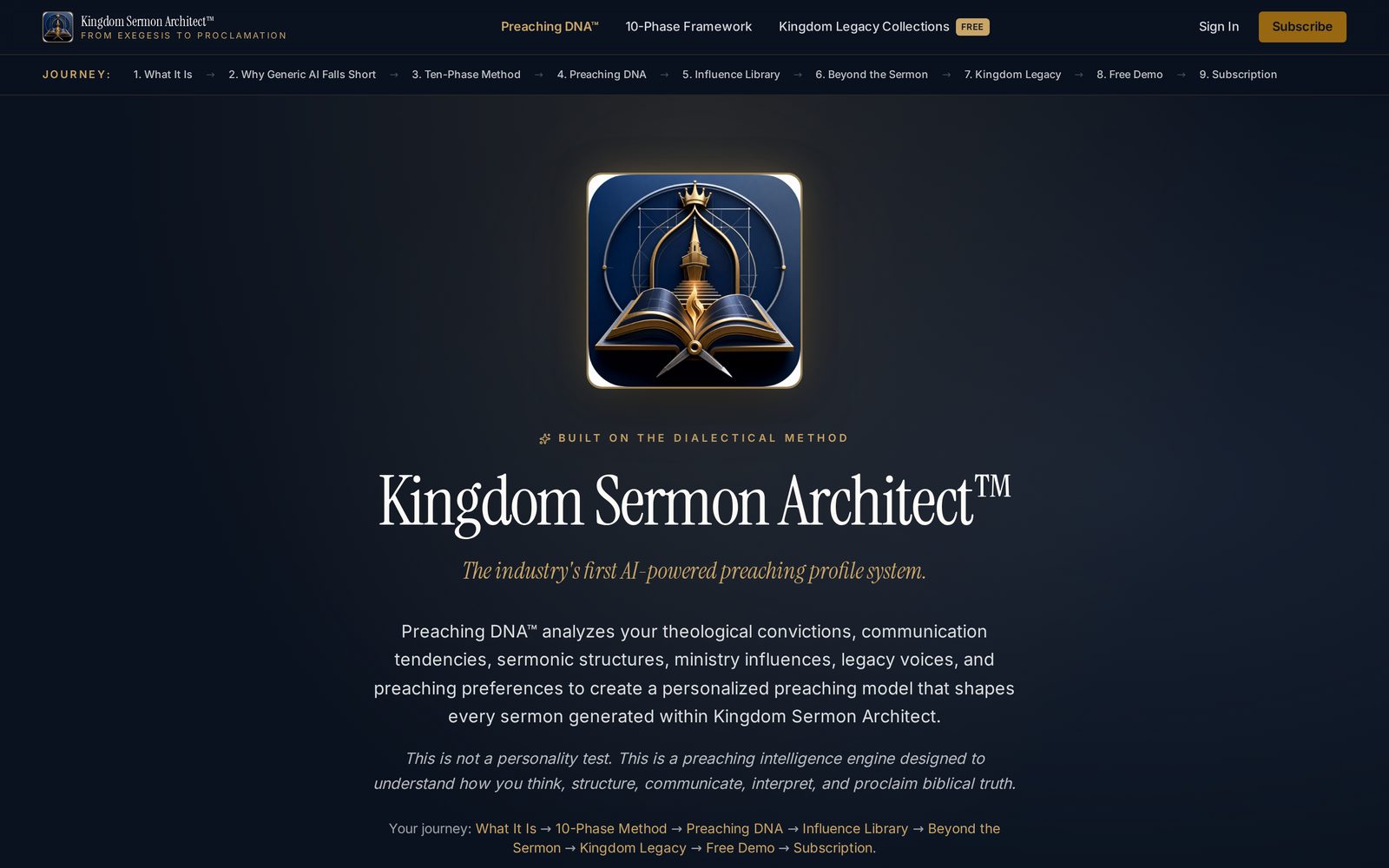
Preachers regularly move from biblical study to proclamation under real time constraints. Generic AI tools ignore theological method; traditional workflows can feel isolating. Pastors need a structured companion that honors sound preaching practice.
Framework Applied
Designed and shipped an AI-powered sermon development platform that guides the preacher through a structured theological workflow — study, interpretation, structure, application, delivery — informed by respected preaching traditions, with the pastor in the lead at every step.
Business Outcome
A live platform pastors and Bible teachers use to strengthen sermon development from exegesis to proclamation — with theological method preserved and the preacher's voice always in front.
AI Experience Framework™ Case Study
Business Challenge
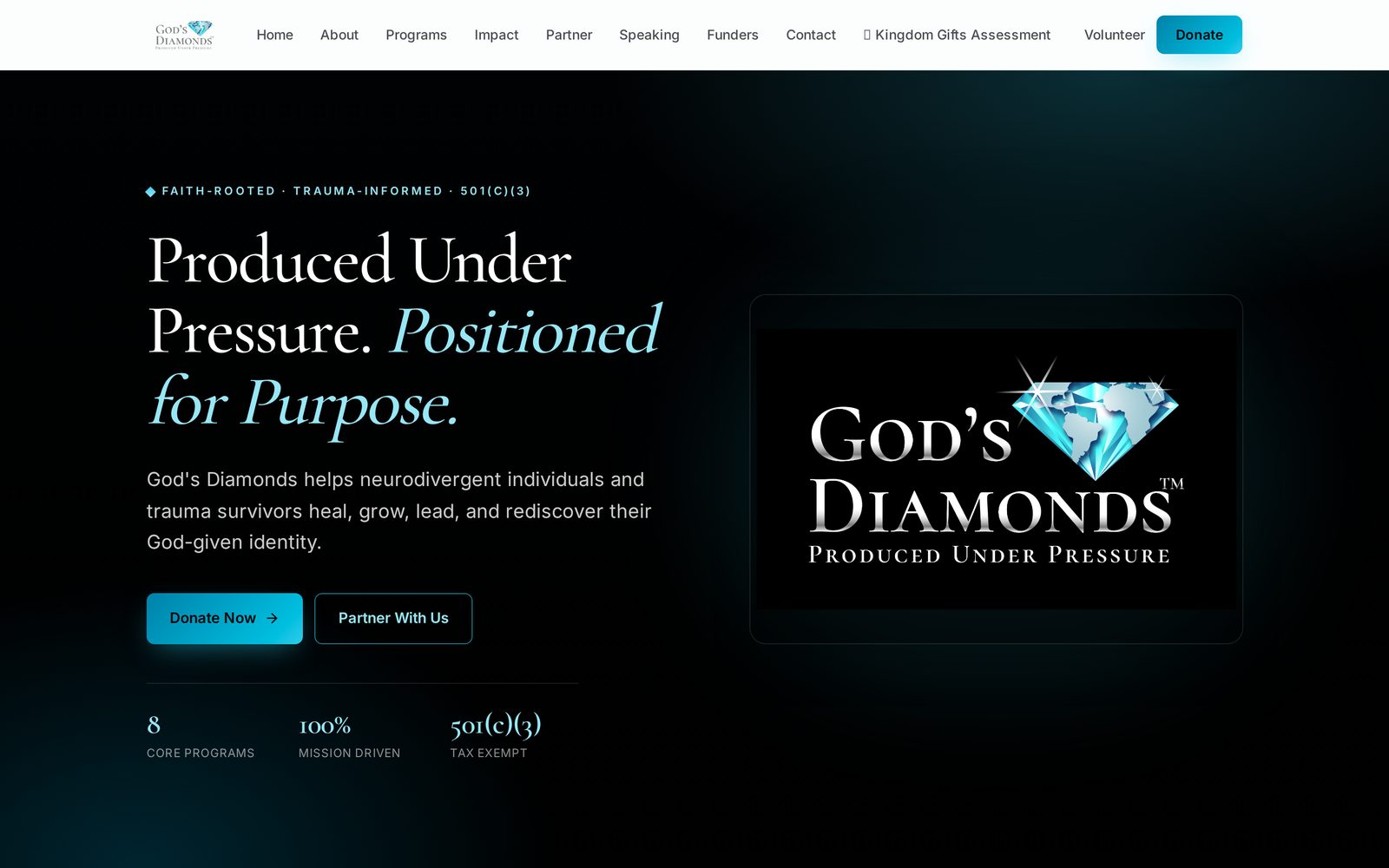
Many believers struggle to understand their spiritual gifts and how to use them within their churches, communities, and everyday lives. Most assessments stop at a category label — leaving no personalized next steps for stewardship and service.
Framework Applied
Designed and shipped a mission-aligned digital assessment for God's Diamonds: a guided, scripture-anchored questionnaire, AI-assisted interpretation of the results, a personalized gift profile, and individualized recommendations for service — all inside a free, mobile-friendly nonprofit resource.
Business Outcome
A live assessment that makes spiritual-gifts education accessible, encourages deeper engagement with biblical learning, gives each participant concrete next steps for service, and models responsible AI adoption for a small faith-based nonprofit.
Industries Served
The AI Experience Framework™ is written for community-rooted organizations — faith-based institutions, nonprofits, and small independent businesses — that want to adopt AI with purpose, trust, and dignity.
The AI Experience Framework™ is not a single solution — it is a repeatable methodology for designing trustworthy, mission-aligned AI experiences inside ministries, nonprofits, and small independent businesses.
Educational offerings
An independent educational framework for AI literacy, responsible AI leadership, and AI experience design. Offerings include leadership education, AI literacy workshops, ministry & nonprofit AI workshops, small-business AI adoption workshops, speaking engagements, research collaboration, framework licensing (future), and books & publications — not consulting engagements.
Deep instructional content — lesson plans, speaker notes, workshop guides, decks, workbooks, exercises, and facilitator scripts — lives in the Facilitator Portal. Facilitator Login →
Leadership workshop
A highly interactive half-day educational workshop that equips leaders to build responsible AI experiences and organizational AI literacy using the AI Experience Framework™. Together, we’ll apply the framework to one of your organization’s highest-priority AI learning questions and leave with practical next steps your leadership team can begin practicing immediately.
Workshop options
Three formats90 Minutes
A concise educational overview of the AI Experience Framework™, AI Heartbeat™, and practical principles for responsible AI leadership and AI literacy.
Ideal for
Half Day
An interactive working session where leadership teams apply the AI Experience Framework™ to one of their organization's most important AI opportunities.
Deliverables include
Full Day
A deeper educational experience that includes facilitated exercises, collaborative planning, governance discussion, prompt architecture instruction, and leadership learning roadmap development. Ideal for organizations preparing to build long-term AI literacy and responsible AI practices.
Designed for
What leaders leave with
“The goal isn’t simply to adopt AI.
It’s to lead AI in a way people trust.”

Executive credentials
Meet the creator
Independent creator of the AI Experience Framework™. Educator, researcher, and thought leader on responsible AI, AI literacy, and organizational learning. Ordained minister.
Organizations do not need more AI tools. They need people who know how to learn, teach, and lead with AI so it is trusted, adopted, and stewarded well.
Kimberly’s independent scholarship draws on decades of leadership across strategy, organizational development, technology, and education — disciplines she now brings to a defining shift for mission-driven organizations, universities, ministries, nonprofits, and growing businesses: the responsible, ethical adoption of artificial intelligence.
The AI Experience Framework™ is her response — an independent educational methodology that helps leaders align learning, governance, culture, and the human experience of AI so organizations build lasting AI literacy and responsible AI practices.
Education & recognition
A personal invitation
“Whether you are developing an AI strategy, educating executive leaders, launching responsible AI initiatives, or transforming how your organization works, I would welcome the opportunity to discuss how the AI Experience Framework can support your goals.”
— Kimberly J. Lewis, M.Div.